A Homily for the 9th Sunday After Trinity
The Rev. Michael Vinson+ Rector
Grant to us, Lord, we beseech thee, the spirit to think and do always such things as are right; that we, who cannot do any thing that is good without thee, may by thee be enabled to live according to thy will; through Jesus Christ our Lord. Amen.
The Epistle. 1 Corinthians 10:1-13; The Gospel. Luke 15:11-32
Trinitytide is the second half of the Christian liturgical year. It began on Trinity Sunday, when we revered and glorified the Divine Trinity—Father, Son, and Holy Spirit—by whom we have become inheritors of eternal life through the merits and death of the Lord Jesus Christ, and were led to contemplate the baptismal confession we made, or which was made on our behalf.
And we prayed that our Lord "would keep us stedfast in this faith and evermore defend us from all adversities" as we travel the pilgrim road unto everlasting life. Thus, Trinitytide is the season in which we strive to live out our baptismal confession and duties, and fulfill the vows made to God and his church. As we do so, our growth in virtue, charity, and fidelity remains the great emphasis placed upon every baptized Christian, that we may grow in love toward God and others—for the aim and end of Christian spirituality is love.
The spiritual life is filled with obstacles and challenges, both from without and within. Prayer is God's gift by which we draw near to listen to him, uniting us to the Father through the Son and by the Holy Spirit, and reminding us that we are not alone on the wilderness journey. We are accompanied by the Lord of life, our redeemer, and sustainer. I love Him. I know that each of you who have been brought from death to life through faith and baptism (1 John 3:14) do as well. And like me, I know you desire to live out your baptism in a manner that pleases him.
Today's Collect for the Ninth Sunday After Trinity asks God for a very particular grace: "the spirit to think and do always such things as are right; that we, who cannot do any thing that is good without thee, may by thee be enabled to live according to thy will." This prayer assumes a few uncomfortable truths. One is that we don't always do things that are right, and we can't do anything good without God. A second is the possibility, even for us, even now, that we are capable of doing something which displeases God. I want us to sit with this for a moment. As we have heard from St. Paul, like our ancient forefathers in the wilderness, we pilgrims can displease our Lord.
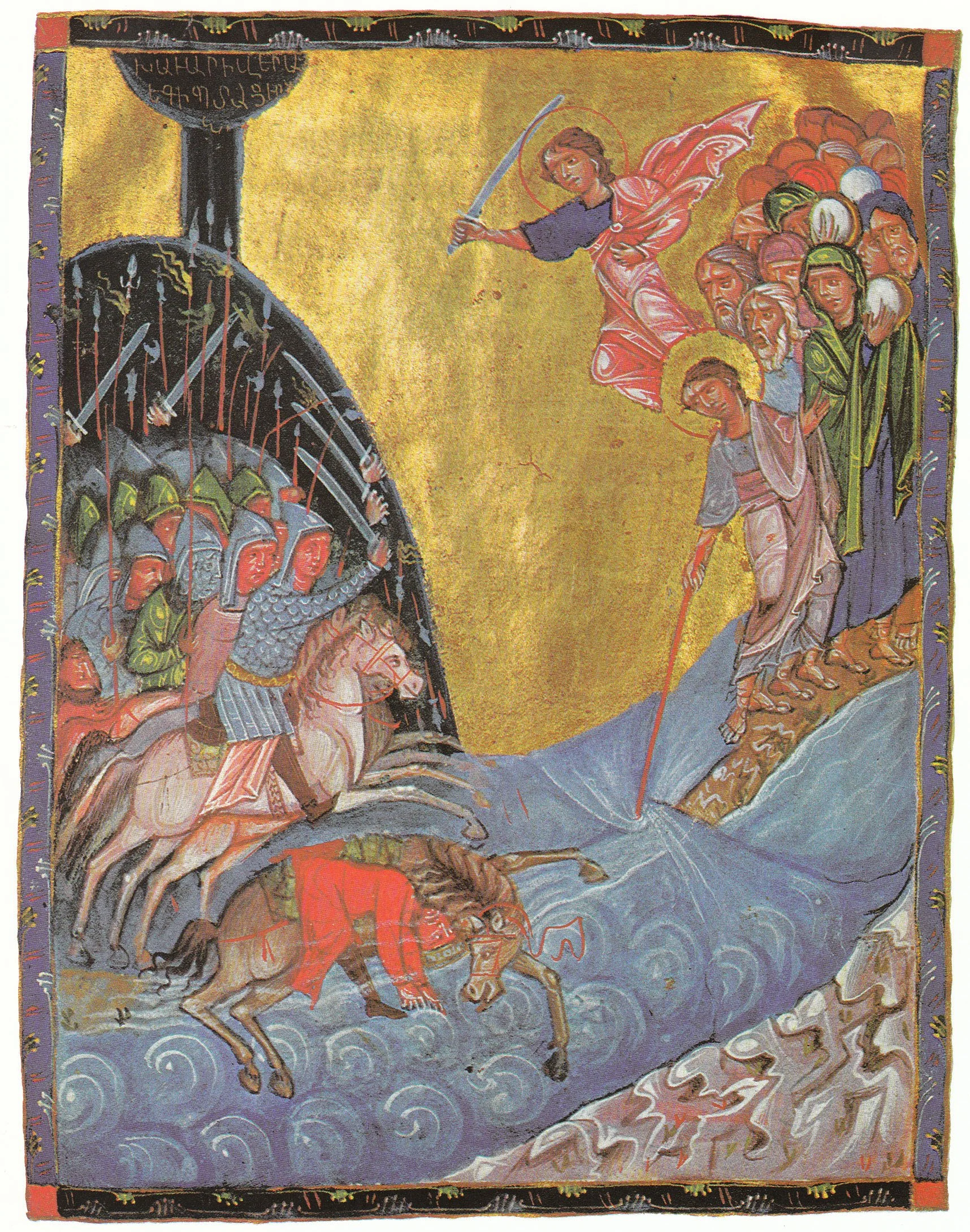
St. Paul says as much to the church in Corinth by holding up the example of Israel: "Brethren, I would not that ye should be ignorant, how that all our fathers were under the cloud, and all passed through the sea; and were all baptized unto Moses in the cloud and in the sea; and did all eat the same spiritual meat; and did all drink the same spiritual drink: for they drank of that spiritual Rock that followed them: and that Rock was Christ. But with many of them God was not well pleased: for they were overthrown in the wilderness."
Every privilege we might claim for ourselves, Israel already had—the pillar of cloud, the parted sea, a baptism into their deliverer, Christ the Rock with them and following them into the wilderness to feed and quench their thirst. And still, Paul says, God was not well pleased. Privilege did not protect them. Spiritual food did not inoculate them. The Divine presence was in their midst, and yet something went wrong. Many of them displeased God and were overthrown in the wilderness. Paul tells us exactly how: "these things were our examples, to the intent we should not lust after evil things, as they also lusted." God's people lusted after evil things. The deadly vice called lust. This is the root of God's displeasure—lusting after lesser loves, instead of thirsting for the living God.
And notice: this was not a thirst born of deprivation. Paul has already told us they "did all drink the same spiritual drink: for they drank of that spiritual Rock that followed them: and that Rock was Christ." They had already tasted the very water that could satisfy every longing they had—and still, some of them thirsted after something else. It was not the absence of Christ that undid them. It was a heart that had tasted him, and still they lusted.
The Apostle shows us what it looks like when lust takes root and bears its evil fruit: "Neither be ye idolaters, as were some of them... Neither let us commit fornication, as some of them committed... Neither let us tempt Christ, as some of them also tempted... Neither murmur ye, as some of them also murmured." Idolatry. Fornication. Testing Christ. Murmuring. Four branches, one root—lusting after evil. God was not pleased with many of them because not only did they do what was wrong in his sight, but they also tempted, or tested, Him in the wilderness and brought Divine judgment upon themselves: snakebitten and swallowed by the earth.
St. Paul would caution us as he cautioned the Corinthian Christians, "Neither let us tempt Christ, as some of them also tempted, and were destroyed of serpents." He is alluding to Numbers 21, where the people, weary of the journey, reproached Moses and cried that "our soul loatheth this light bread." Mark this well: temptation grows fastest in the soil of dissatisfaction, impatience, and frustration.
They tempted Christ in the wilderness, meaning they pushed against his patience with their lusting, fornication, and murmuring to see how far he would go, and whether He would suffer their unbelief, impatience, and infidelity to pass unpunished. They were daring him by trying his patience with rebellion and sin. Moses told them, "Ye shall not tempt the LORD your God, as ye tempted him in Massah" (Deuteronomy 6:16)—a command our Lord himself quoted in his own wilderness, refusing the devil's invitation to throw himself from the temple and force his Father's hand—"Thou shalt not tempt the Lord thy God" (Mt. 4:7). To test God is to press against his patience, daring mercy to find its limit. This too displeases him—not because his patience runs thin, but because presumption refuses the very trust he asks of us.
It is tempting to leave all this safely in the past, addressed to a people and a church we have never known. But our Gospel will not let us keep that distance—the testing we find there brings it much closer to home. The Prodigal Son tests his father, saying, "Father, give me the portion of goods that falleth to me." This is not a humble request. Asking for his inheritance while his father still lives treats the father as good as dead—a source of goods to be extracted, not a father to be loved. And his whole venture into the far country becomes a kind of experiment: can I actually live without him? Israel asked the same question in the wilderness, wondering aloud whether they might have fared better back in Egypt. Both answers arrive the same way—not as punishment, but as a famine exposing what self-sufficiency and defiance always yield.
Self-sufficiency and defiance are never the whole of it, though—underneath both is the same desire that breeds rebellion. Paul was specific that Israel's fathers "lusted after evil things," and that lust bore two fruits in particular: idolatry and fornication. The son's far country produces the same two. Luke tells us he "wasted his substance with riotous living"—harlotry, in his own brother's blunter word. In that country he built a life around whatever his appetite demanded, answering to no one but himself. That is idolatry in its plainest form—not a wooden statue on a shelf, but a life reorganized around a god of his own making, set up in his heart, the place his father once held. And it is fornication in its plainest form as well, desire pursued without restraint, exactly as Israel's desire ran loose at Baal-peor. The famine that follows is what Israel's whole history has already shown us: lust always outruns what it can buy, and a heart that has stopped thirsting for God will eventually find itself starving.
Look at the shape of his story, and Israel's own history traces itself beneath it, point for point. Israel receives a promise and a land by grace, not merit—the son receives "the portion of goods that falleth to him," also by grace, before he has done anything to deserve it. And when want comes to each of them, both are tempted to imagine that bondage was better than the freedom they were given—Israel longing for the fleshpots of Egypt, the son ready to settle for a hired servant's wages rather than the riches of sonship. The prodigal son doesn't merely resemble Israel. He replays her—the whole exodus and wilderness compressed into one household, one road, one famine.
This is what makes the son's testing nearer to us, because we recognize the prodigal in ourselves. We do not usually test Christ by asking him to turn stones to bread or to catch us as we fall from a temple. We test him the way the son tested his father—with the same lusts that undid Israel: idolatry, fornication, and murmuring, each one now wearing a far more ordinary face.
Every time we treat God's forgiveness as a certainty that frees us to keep sinning a little longer, rather than a costly gift that calls us to repent and amend our ways, we are doing exactly what the prodigal did—asking for what grace will give before we have offered the love and obedience a father is owed. What would the apostle tell us? Are we to continue in sin that grace may abound? "God forbid. How shall we, that are dead to sin, live any longer therein?" (Rom. 6:1-2). We are daring his patience to see just how far His mercy will go before judgment answers. This, beloved, is what displeases God—not the dramatic rebellion of the wilderness only, but the presumption of a heart that has stopped trusting God and is testing him instead.
"Now all these things happened unto them for ensamples: and they are written for our admonition, upon whom the ends of the world are come." My friends, our gracious God through the Spirit is warning us today through the cautionary stories of Israel and the Prodigal: do not lust after evil things as they also lusted. And to those who feel no pull toward the far country at all—who are sure they would never squander what they've been given—Paul has a word for you too: "Wherefore let him that thinketh he standeth take heed lest he fall." Feeling steady is no proof of standing firm. It may be the very moment we are least aware of our need, unless our confidence rests in God's grace and not in ourselves.
But St. Paul does not leave that warning in isolation. In the very same breath, he turns from what we do to God to what God does for us—and this changes everything: "There hath no temptation taken you but such as is common to man: but God is faithful, who will not suffer you to be tempted above that ye are able; but will with the temptation also make a way to escape, that ye may be able to bear it." Here, God is not being tested by us; he is testing—or trying—us, and Paul wants us to understand two things about it.
First, the trials that come to you and to me are "common to man"—the ordinary temptations to which all people are susceptible: eyes looking upon what they should not, hearts envying what others have, tongues quick to speak ill. These are common to the human experience, not the uncommon, supernatural assault the devil leveled directly at Christ in the wilderness.
Second, every "you" in his sentence is plural. The experience of testing is never presumed by the Apostle to be borne by any individual alone. Your season of trial is never in isolation. As the death of a spouse is experienced by the whole family, others will always be bearing it with the one being tested—like the father in our Gospel, who was not untouched by his son's absence, but watched, prayed, sorrowed, and hoped for him on the road long before the son ever came into view.
Friends, displeasure is never God's last word. The final word spoken over his people in the wilderness is faithfulness. God's faithfulness, Paul says, always provides "a way to escape"—in the Greek, an ekbasis, literally a way out, an exit, the same word-family that gives us the word exodus. God's faithfulness does not usually mean the trial is lifted before it is finished; it means a door is provided through it. The exodus for the prodigal begins in the same manner as it does for us—repentance.
"And when he came to himself, he said, I will arise and go to my father, and will say unto him, Father, I have sinned against heaven, and before thee, and am no more worthy to be called thy son." The road back to pleasing our Father begins by walking through the door of repentance and saying, "I am sorry. I have sinned against you. Forgive me." "I am the door," says Jesus. "By me if any man enter in, he shall be saved, and shall go in and out, and find pasture" (John 10:9). My friends, if you will repent of your sins and turn to Christ, he will lead you on the exodus out of sin and destruction and into the fullness of life, both now and in the life to come. Nothing pleases a Father more than the return of his child. Amen+